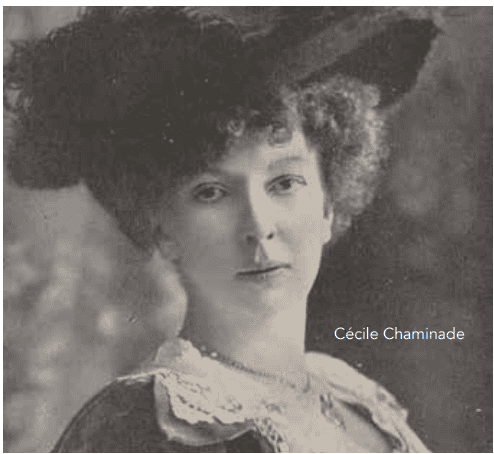
Cécile Chaminade (1857 - 1944)
Callirhoë Suite
16 minutes
Composer: Cécile Chaminade (Born in Paris, France, in 1857; died in Monte Carlo, Monaco, in 1944)
Work composed: 1887
World premiere: Premiered in 1888 at the Grand Theatre in Marseille, France, as a full ballet
Instrumentation: 2 flutes, piccolo, 2 oboes, 2 clarinets, 4 bassoons, 4 horns, 4 trumpets, 3 trombones, tuba, timpani, 3 percussion, harp, and strings
Callirhoë Suite, Op. 37
I. Prélude
II. Scène champêtre
III. Fête arabe
IV. Scherzettino
V. Passepied
VI. Sarabande
VII. Valse
VIII. Marche solennelle
Pyotr Ilyich Tchaikovsky (1840 - 1893)
Francesca da Rimini
22 minutes
Composer: Pyotr Ilyich Tchaikovsky (Born in Votkinsk, Russia, in 1840; died in Saint Petersburg, Russia, in 1893)
Work composed: 1876
World premiere: Premiered on March 9, 1877, in Moscow, conducted by Nikolai Rubinstein
Instrumentation: 3 flutes 3 oboes, 2 clarinets, 2 bassoons, 4 horns,4 trumpets, 3 trombones, tuba, timpani, 3 percussion,
harp, and strings

If Romeo and Juliet is Tchaikovsky’s symphonic poem of star-crossed devotion, Francesca da Rimini is its darker twin—a descent into the whirlwind of forbidden love, sin, and damnation. Inspired by Dante’s Inferno, this 22-minute symphonic poem brims with drama and despair.
Composed in the autumn of 1876 during one of Tchaikovsky’s most creatively fertile periods, Francesca da Rimini sprang from Canto V of Dante’s Divine Comedy, where the poet visits the second circle of Hell, the realm of the lustful, and meets the ill-fated lovers Francesca da Rimini and Paolo Malatesta.
Their crime was passion; their punishment, to be eternally swept through a storm of fire and wind, unable even in death to find rest.
The work opens in darkness. A low murmur in the strings swells to a seething restlessness. This is Dante’s descent into Hell. Slowly, clarinet and bassoon intone a brooding theme that becomes the shadowy foundation of the entire piece. The music surges and retreats, waves crashing in orchestral
crescendos, until the storm fully arrives.
The central section, the heart of the narrative, recounts Francesca’s doomed affair with her brother-in-law, Paolo. Tchaikovsky’s gift for melody shines here with tragic tenderness. A solo clarinet offers a theme of yearning. Soon, the
strings take up the theme, rich and full of ache. This is passionate and inevitable love, already tinged with grief. The texture swells, the harmonies darken, and the music blooms into a cry of rapture just before the fall.
And fall they do. The lovers are discovered, condemned, and cast into the eternal whirlwind. Tchaikovsky unleashes the full force of the orchestra, the tempo becomes breathless, the harmonies twisted, and the momentum nearly impossible to contain.
But even in the chaos, Tchaikovsky finds room for a glimpse of human feeling. As the final pages approach, the love theme briefly re-emerges, torn and distorted. The music builds to a final scream—a blazing, agonized climax—and then collapses into silence.
There is no resolution, no absolution. Francesca da Rimini ends not with redemption. The storm doesn’t clear; it simply consumes. This is a work that does not just illustrate a story, but embodies it. We do not watch Francesca’s fate; we feel it.
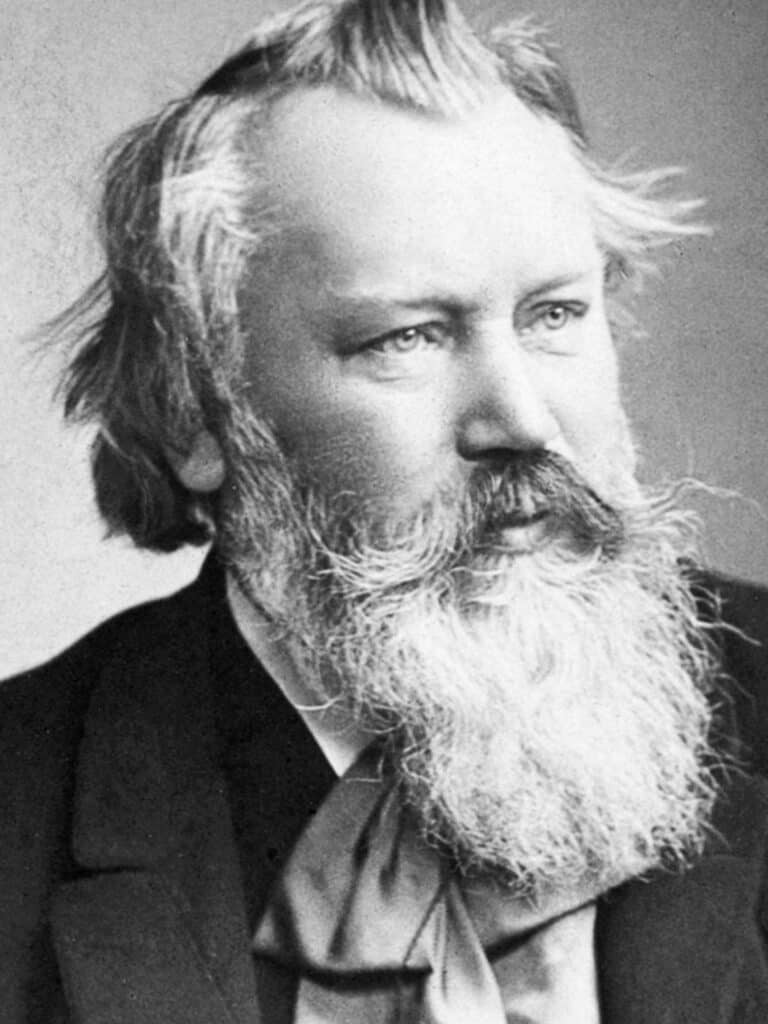
Johannes Brahms (1833 - 1897)
Piano Concerto No. 2
44 minutes
Composer: Johannes Brahms (Born in Hamburg, Germany, in 1833; died in Vienna, Austria, in 1897)
Work composed: Completed in 1881, with sketches dating back to the late 1870s
World premiere: Premiered on November 9, 1881, in Budapest, with Brahms himself as the soloist and Alexander Erkel conducting the Budapest Philharmonic Orchestra
Instrumentation: Solo piano, 2 flutes (2nd doubling piccolo), 2 oboes, 2 clarinets, 2 bassoons, 4 horns, 2 trumpets, timpani, and strings
Piano Concerto No. 2 in B major, Op. 83
I. Allegro non troppo
II. Allegro appassionato
III. Andante
IV. Allegretto grazioso
A full decade passed between Brahms’s first and second piano concertos—and in that time, the composer matured from a promising, sometimes stormy Romantic into a figure of Olympian gravitas. If his First Piano Concerto is a work of youthful turmoil, then the Second is a masterwork of balance. Brahms himself, with characteristic dry humor, described the piece as “a little concerto with a little wisp of a scherzo.” The joke, of course, is that this “little” concerto spans four movements, lasts nearly 45 minutes, and is one of the most formidable works in the repertoire.
The first movement, Allegro non troppo, begins with grace: a quiet solo horn call, answered by the piano in a gentle cascade. It is a remarkable opening—modest, understated, and inward-looking. But this is Brahms, and emotion soon deepens. The piano writing is warm, often conversational, sometimes
erupting into thunderous octaves, but always returning to lyricism.
The second movement, Allegro appassionato, is the fire within the stone. Here is Brahms at his most tempestuous: a surging, dramatic scherzo set in D minor, full of biting syncopations and rhythmic swagger. Yet even here, Brahms cannot resist introspection—a more lyrical middle section offers a brief clearing
in the storm before the fury returns. It’s the emotional fulcrum of the entire concerto, and a movement whose inclusion defies concerto tradition, deepening the work’s expressive palette.
The third movement, Andante, begins with a solo cello playing a gentle, expressive melody—more reflective than dramatic. The piano enters not to dazzle, but to support, adding warmth and depth to the conversation. In the middle section, the music grows more restless, like a surface briefly disturbed, before settling back into its original calm. Brahms’s writing here feels intimate, almost like chamber music, with a careful blending of voices that highlights his sensitivity to texture and tone.
The finale, Allegretto grazioso, is Brahms at his most genial and unbuttoned. Marked by buoyant rhythms and rustic charm, it dances like a Hungarian folk tune filtered through Viennese elegance. Unlike the heroic summits of other Romantic finales, this one chooses delight over drama. It is a movement that smiles—not because life is simple, but because it is rich, complex, and full of grace.
Piano Concerto No. 2 stands as a monument to Brahms’s mature voice: emotionally layered, structurally profound, and executed with a composer’s quiet confidence rather than youthful showmanship. In doing so, it reveals something rare: the wisdom of restraint, the poetry of conversation, and the profound beauty of craft honed over time.