Outi Tarkiainen (1985-)
The Ring of Fire and Love
9 minutes
Composer: Outi Tarkiainen (Born in Rovaniemi, Finland, in 1985)
Work composed: 2020
World premiere: Premiered on March 18, 2021 at the Royal Stockholm Philharmonic Orchestra, conducted by Sakari Oramo.
Instrumentation: 2 flutes (doubling piccolo), 2 oboes, 2 clarinets, (2nd doubling bass clarinet), 2 bassoons, 4 horns, 2 trumpets, 3 trombones, tuba, timpani, 3 percussion, harp, celesta, and strings

In Outi Tarkiainen’s The Ring of Fire and Love, music becomes the body—expanding, contracting, bearing pain and rapture in equal measure. Composed in 2020, this concerto is a meditation on motherhood, on the elemental forces that forge life, and on love so intense it threatens to split the earth.
Tarkiainen, born in the far north of Finland under the Arctic sky, is known for weaving together sound worlds that feel both mythic and visceral. Her music is often shaped by nature, folklore, and womanhood, yet it never leans on cliché. In The Ring of Fire and Love, she turns inward and downward, into the primal experience of childbirth.
The title refers to a phrase familiar to many who have given birth: the “ring of fire” is the moment during labor when the child begins to emerge. Tarkiainen offers the feeling of birth: raw, ecstatic, terrifying, miraculous.
The structure is not linear, but cyclical, tidal. Themes bloom and recede like contractions—surges of energy and emotion that crest and fall away. There are no sharp movements or declarative themes. The orchestration is luminous and tactile. Celesta, harp, and high winds glitter like distant stars, lower brass and percussion groan. But for all its beauty, this is not easy music. It aches. It labors.
Midway through, the music intensifies. Phrases stretch longer, cry louder. The orchestra moves like a growing tidal surge, layering harmony over harmony until it feels like the very air might crack open. And then—suddenly, gloriously—it does.
In the final moments, the music subsides into a kind of exhausted awe. The orchestra becomes translucent—just enough to cradle the voice, to say: you made it through. The pain is over. The love remains.
Edvard Grieg (1843-1907)
Piano Concerto in A minor, Op. 16
30 minutes
Composer: Edvard Grieg (Born in Bergen, Norway, in 1843; died in Bergen, Norway, in 1907)
Work composed: 1868
World premiere: Premiered on April 3, 1869, in Copenhagen, Denmark, with pianist Edmund Neupert and Holger Simon Paulli conducting
Instrumentation: Solo piano, 2 flutes, 2 oboes, 2 clarinets, 2 bassoons, 4 horns, 2 trumpets, 3 trombones, timpani, and strings

I. Allegro molto moderato
II. Adagio
III. Allegro moderato molto e marcato
Edvard Grieg’s Piano Concerto in A minor begins with a flourish—a timpani roll, a thunderclap of piano chords, and then a plunging, impassioned theme that seems to dive straight into the heart. It’s one of the most iconic openings in classical music, and one that, even today, feels like a curtain being torn aside. The drama is immediate, the color unmistakable. And behind it all is the voice of Norway.
Grieg composed this concerto in 1868, while staying in Denmark, shortly after the birth of his daughter. He was only 24 years old. Still early in his career but already considered one of the rising stars of Scandinavian music, Grieg sought to write something that would both pay homage to the great Romantic tradition—particularly Schumann, whose own A minor concerto had clearly left its mark—and channel the landscape, folk idioms, and emotional topography of his homeland.
The first movement, Allegro molto moderato, after its commanding opening, presents two contrasting themes: one noble and stormy, the other lyrical and tinged with melancholy. Grieg alternates between sweeping gestures and moments of exquisite intimacy, letting the piano sing and sigh and shimmer through cascading runs and delicate ornamentation. Though the concerto structure remains, Grieg’s voice is clear: Romantic, yes, but unafraid of simplicity and sincerity.
The second movement, Adagio, transports us to another world entirely. Set in D-flat major, it opens with hushed strings, the piano gently entering, almost shyly, spinning out a melody of fragile beauty. Here Grieg is at his most poetic: nothing is rushed, nothing overstated. The harmonies drift like mist across a fjord, and the textures are spacious and hushed, leaving room for silence and breath.
Then comes the finale, Allegro moderato molto e marcato, which bursts forth with a rhythmic dance inspired by Norwegian folk forms—specifically, the halling, a traditional leaping dance from the mountains. The piano bounces, drives, and dances, often in offbeat rhythms, while the orchestra cheers it on with syncopated punctuation and bursts of brass. This is Grieg in full national color, joyful and rhythmic, but never frivolous. The central section of the movement shifts into a lyrical reverie—gentle, flowing, almost like a lullaby before the dance returns with renewed vigor.
Grieg’s Piano Concerto speaks in the language of heart and homeland, of open landscapes and quiet yearning. And through its passion, intimacy, and radiant lyricism, it offers something rare: music that feels both personal and universal, modest in ambition yet unforgettable in impact.
Dmitri Shostakovich (1906-1975)
Symphony No. 1 in F minor, Op. 10
28 minutes
Composer: Dmitri Shostakovich (Born in Saint Petersburg, Russia, in 1906; died in Moscow, Russia, in 1975)
Work composed: 1923–1925
World premiere: Premiered on May 12, 1926, at the Leningrad Philharmonic, conducted by Nikolai Malko
Instrumentation: 3 flutes (2nd and 3rd doubling piccolo), 2 oboes, 2 clarinets, 2 bassoons, 4 horns, 3 trumpets, 3 trombones, tuba, timpani, 4 percussion, piano, and strings
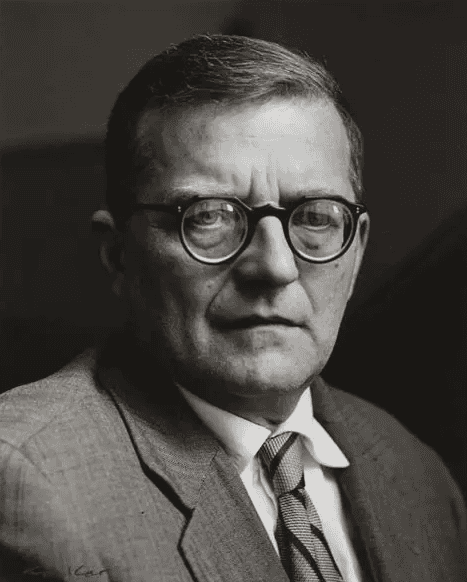
I. Allegretto – Allegro non troppo
II. Allegro
III. Lento
IV. Allegro molto
What were you doing when you were 19?
Dmitri Shostakovich, at that age, was finishing his graduation piece from the Petrograd Conservatory—a full symphony that would catapult him into international stardom and cement his place as one of the most original compositional voices of the 20th century. Symphony No. 1, completed in 1925 is a youthful fireball of wit, satire, and defiant elegance. And even in its most playful moments, there’s a knowing darkness just beneath the surface—a shadow that would follow Shostakovich for the rest of his life.
The Soviet Union in the 1920s was a strange place: still newly formed, culturally experimental, politically volatile. The arts were in flux, teetering between wild innovation and looming control. Into this moment strode young Shostakovich—cheeky, brilliant, already playing with matches. While his First Symphony wears the clothes of classical tradition (you’ll hear echoes of Haydn, Beethoven, Mahler, and especially Tchaikovsky), the soul beneath is unmistakably his own.
The first movement begins with a prankster’s grin: a solo trumpet fanfare followed by light, skipping woodwinds. It’s a musical wink, a curtain lifted. Then the piano sneaks in—rare in symphonies of the time—adding percussive sparkle and a dash of unpredictability. Shostakovich sets up expectations only to knock them over with a smirk. It’s razor-sharp musical mischief.
The second movement, a scherzo marked Allegro, is even more unhinged—biting brass interjections and off-kilter rhythms. The piano returns here as an impish accomplice, scattering notes like shards of broken glass. One moment it’s carnival; the next, it’s cabaret in a crumbling empire.
But then comes the third movement, and the mood darkens. Marked Lento, this is a slow movement of startling maturity. A plaintive oboe sings over hushed strings. The irony and swagger of the earlier movements give way to raw introspection. The music rises in anguished surges, but always returns to quiet.
Without pause, the final movement crashes in. It begins with a jolt—like someone waking from a dream. This is the most overtly dramatic section of the symphony, full of contrasts: blistering brass, mournful solos, chattering woodwinds, and sudden silences that feel like breath held too long. As the symphony reaches its close, the theme rises in the strings and then is hammered home by the full orchestra. Is it victory? Defiance? Resignation? Even Shostakovich doesn’t say. But the impact is unmistakable.
Symphony No. 1 was an instant success—critics and audiences alike hailed it as the work of a genius. Even the hardened composer Nikolai Malko, who conducted the premiere, reportedly said afterward, “This is not a student work. This is a real symphony by a real composer.”
But this early triumph also set the stage for a life lived under scrutiny. The humor, ambiguity, and daring that defined this piece would later put Shostakovich in danger during Stalin’s regime. And yet, in this first symphony, before the full weight of history descended, we get Shostakovich in the bloom of invention: bold, mischievous, searching, and entirely unforgettable. It is a young artist’s voice, unfiltered and already unforgettable—calling out to his own time, and to ours.